Target reached!
Extra funding will go towards more research, we currently have a research project ru...
Extra funding will go towards more research, we currently have a research project ru...
To conserve, protect and increase the population of native dark honeybee populations on the Isles of Scilly with beekeeping and science.
There are numerous species of honey bee found in the UK, which are largely imported honey bees, mostly from Europe. There is one exception to this, our native dark honey bee, Apis mellifera mellifera (Amm). At the beginning of the 20th century it was thought our native honey bee was extinct due to the Isle of Wight disease. We now know that this was not true, and some populations survived. However, these native honey bees have been subjected to competition from large importations of non-native honey bees which have frequently cross bred with the native strains resulting in hybrids. Nevertheless, we are becoming aware of some pockets of relatively pure and resilient native honey bees thriving in the South West of the UK, and in remote locations such as the Isles of Scilly and the Isle of Man. Many people are now working to conserve the native honey bee.
Importation of honey bees has also introduced a parasite called the Varroa mite which is now widespread across the British Isles. The varroa mite itself is a vector for diseases including viruses. So far, the Isles of Scilly honey bees remain Varroa-free, and we are anxious to keep it that way!
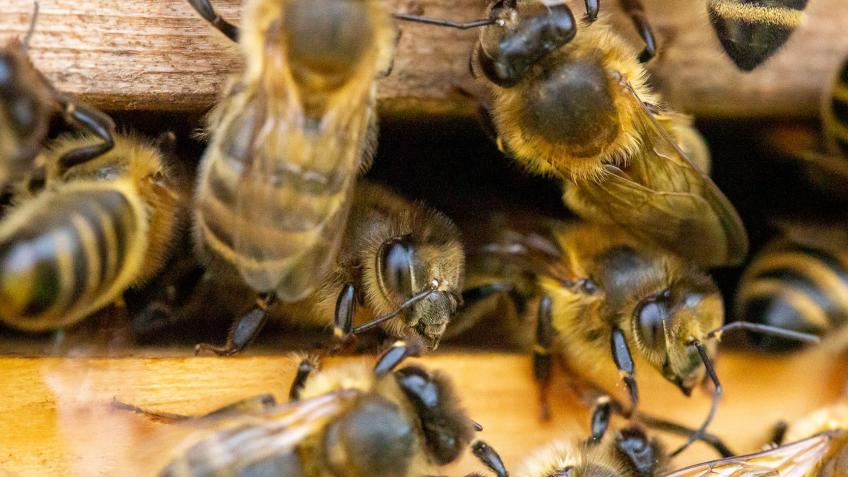
Apis mellifera mellifera has evolved over thousands of years to be best suited for the environment and climate of the UK and Northern Europe. The native dark honey bee has darker and longer fur, which keeps it warmer and allows it to collect nectar in cooler weather than imported bees which are more suited to the warmer weather of mid and southern Europe. This means pollination of plants can occur earlier in the year, even if the weather is cool. Imported honey bees struggle to adapt to our cold weather and are less likely to survive our winters. The native honey bee is best suited for the environment in the UK, but it is needing all of our support.
The Scillonian bee project is a community based, non-profit organisation representing a group of beekeepers whose aim is to protect the native dark honey bee, Apis mellifera mellifera, on the Isles of Scilly. Our purpose is to conserve, protect and increase the population of Amm with beekeeping and science.
The honey bees on the Isles of Scilly are special because they have been largely isolated from the UK which has allowed for the native honey bees to continue on with little interference from high levels of imported bees. Because of this, the Isles have also managed to remain varroa mite-free which greatly helps the bees stay healthy. The specific characteristics of the bees on the Isles of Scilly are still mostly unknown and much more research is being done to understand these bees a little bit more.
The Scillonian bee project is working in partnership with the B4 group. B4 was established 5th March 2013, its purpose is to protect the British Isles native dark honey bee. The B4 group is an entirely voluntary organisation and it relies on goodwill and grant funding. B4 aims to transfer ownership of the future of the native honey bee to beekeepers within the beekeeping community and other supportive public educational institutions.
The Scilly bee project is proving a beekeeping organisation to the beekeepers on the Isles of Scilly that until now, have always practised their beekeeping independently. Involvement with the project is facilitating an easy exchange of information about practices and research whilst giving them a voice. The beekeepers often have a wealth of experience and knowledge of bees on the islands which is of immense use to scientists and bee experts from the mainland.
We are involved with lots of research projects and work with many organisations such as Plymouth University, Pollenize and BIBBA, to name just a few. With some of our work we are looking into bee genetics, and specifically how hybridised the colonies are. In may 2021, samples of honeybees were sent to genetic experts at the Roslin Innovation Centre in Edinburgh. This is to look into if our strain of honeybees are uniquely adapted to the conditions on the Isles of Scilly.
We also work closely within the local community and schools, who have eagerly supported this project. Younger children have participated by planting a wild flower meadow; and the older students at the Five Islands academy engaged in a study which tried to map the movement of drones around and between the islands to explore the implications of this on breeding bees.
We collaborate with the community and local beekeepers across the Isles of Scilly to involve as many people and beekeepers as possible in the protection of Amm.
The more we can research these bees and work alongside beekeepers and conservation organisations, the more we can help these bees and protect the species. The project has very strong local support and has been endorsed by the Duchy of Cornwall, the Wildlife trust, and the Isles of Scilly Council.
Now is the most important time to protect our bees and pollinators, and we can only continue with our work with the support from organisations and the public. Donations for our work will go towards research, supplies, equipment and local help. Let us work together to help Apis mellifera mellifera.

Aviva Community Fund provided £1,650 of match funding
This project successfully funded on 12th April 2022